
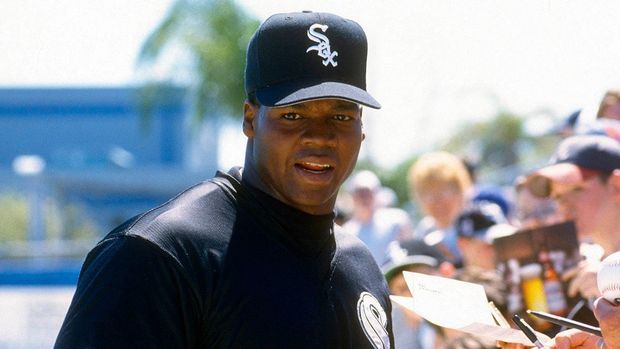
Frank Thomas’ latest clash with the Chicago White Sox says as much about legacy and respect as it does about a single social media post. At the start of Black History Month 2026, the Hall of Famer publicly ripped his former team after realizing he was effectively missing from a team graphic meant to celebrate Black milestones in franchise history.
The graphic that set him off
On February 1, the White Sox posted a timeline-style Black History Month graphic highlighting “momentous firsts” and key milestones for Black players, executives and moments in club history. The post mentioned events such as Comiskey Park hosting the first Negro Leagues All-Star Game, Al Smith becoming the first Black All-Star for the team, and current manager Will Venable’s place as the third Black manager in franchise history.
But there was no clear, stand‑alone mention of Frank Thomas, despite the fact that he is widely regarded as the greatest player in franchise history and holds a long list of offensive records. At most, he appeared only as a passing reference within a note about Dick Allen’s MVP award, without his own bubble or spotlight on the graphic. For Thomas, that omission turned what was supposed to be a celebration into a fresh reminder of old wounds.
“I’m taking receipts”: Thomas responds
Thomas responded quickly and sharply on social media, quote‑tweeting or commenting on the post to call out the franchise that drafted him and rode his bat to relevance. In a pointed message, he wrote some variation of: “I guess the Black player who made you rich over there and holds all your records is forgettable! Don’t worry, I’m taking receipts!”
The post resonated with fans, quickly drawing far more engagement than the original team graphic and sparking debate about how the organization views its greatest star. Many supporters argued that if a Black History Month timeline about the White Sox cannot find room to properly feature the club’s all‑time home run leader and a back‑to‑back MVP, then something is fundamentally off in how the franchise recognizes Black excellence in its own history.
Why the omission stings so much
Thomas’ reaction can’t be separated from his résumé or from his complicated history with the organization. Nicknamed “The Big Hurt,” he spent 16 of his 19 big‑league seasons with the White Sox, winning consecutive AL MVP awards in 1993 and 1994 and finishing in the top 10 of MVP voting for seven straight years from 1991 through 1997. He was a five‑time All‑Star, four‑time Silver Slugger, AL batting champion in 1997, and one of the most feared right‑handed hitters of his era.
Statistically, Thomas dominates the White Sox record book: he is the franchise’s all‑time leader in home runs (448), runs batted in, runs scored, doubles, walks, on‑base percentage, slugging percentage and total bases. He also authored an extraordinary streak of seven straight seasons with at least a .300 average, 100 RBIs, 100 runs, 100 walks and 20 homers, underscoring his unique blend of power and plate discipline. For many, he is not just one of the best players in club history; he is the best.
Yet the relationship between Thomas and the White Sox has been strained for years. In the mid‑2000s, he clashed publicly with then–general manager Ken Williams, including over a contract clause that reduced his salary and over injuries Thomas believed were mishandled by team doctors, leading to a lawsuit that was eventually settled. After the 2005 World Series season—during which injuries limited him to 34 games and kept him out of the postseason—his contract was bought out, and he finished his career with Oakland and Toronto.
While the White Sox retired his No. 35 in 2010 and he was inducted into the Hall of Fame in 2014, there have been signs the relationship never fully healed. He attended the 10‑year reunion of the 2005 champions but was notably absent from the 20‑year reunion in 2025, fueling speculation that tension remained beneath the surface. Against that backdrop, being effectively sidelined in a Black History Month tribute landed as yet another slight.
Fans see a deeper problem
The reaction from fans and observers went beyond simple outrage on behalf of a star player. Many saw the omission as emblematic of how institutions sometimes mishandle Black history—even when the goal is to celebrate it. In online discussions, supporters pointed out that other figures, such as Bo Jackson and Kenny Williams, appeared multiple times in the graphic while Thomas received at best a vague, shared mention. Some called it “mortifying” that the franchise’s most dominant player, and a Black man who defined the team’s identity through the 1990s, was not given his own space on a graphic specifically built for Black History Month.
Others noted that the White Sox could easily have highlighted Thomas as the first Black player in franchise history to win multiple MVP awards, the first in American League history to win back‑to‑back MVPs as a Black player, or simply as the Black superstar who shattered team records and carried the offense for more than a decade. Instead, fans felt they were watching the organization minimize a central Black figure in its narrative on a day meant to foreground Black contributions.
What this moment reveals about legacy and accountability
Taken on its own, a graphic can seem minor. But for Thomas—and for many who watched him carry the White Sox brand for years—this latest slight fits into a pattern. At a time when many sports organizations are working to tell more complete and honest stories about their Black players, executives and fans, leaving someone like Frank Thomas on the margins of a Black History Month tribute reads less like an oversight and more like a failure to fully reckon with the past.
Thomas’ sharp, public response is a reminder that honoring Black history is not just about posting timelines; it is about who gets centered, who gets footnoted, and who gets left off entirely. His message—“Don’t worry, I’m taking receipts”—signals that players remember how they are treated long after the hits, homers and ticket sales, and that respect for Black history includes respect for the Black legends still very much watching what their former teams do in their name.


