
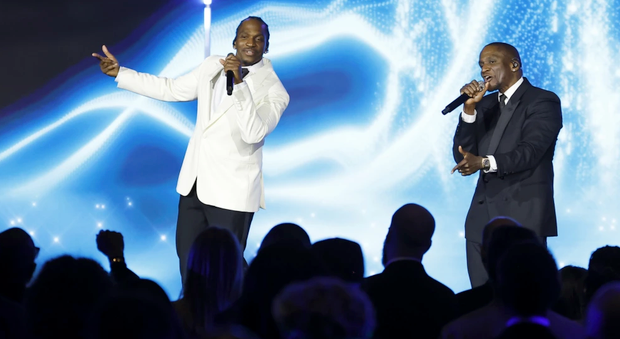
Grammy Week 2026 opened with a love letter to Black music at the Recording Academy Honors Presented by the Black Music Collective, where Pharrell Williams, Brandy, and Kirk Franklin were celebrated as living legends in an evening that felt less like an industry gala and more like a family reunion of artists, storytellers, and the communities that shaped them.
A night that set the tone for Grammy Week
Held at the Fairmont Century Plaza in Los Angeles, the fourth annual Recording Academy Honors gathered artists, executives, and fans to spotlight Black creativity at the very start of Grammy Week. The Black Music Collective’s goal was clear: give Black artists their flowers now, in a room where their history, influence, and cultural impact were centered rather than sidelined.
The honorees reflected three powerful pillars of modern music: Pharrell Williams as a visionary producer and cultural architect, Brandy as a defining voice and image of R&B, and Kirk Franklin as the bridge between church and mainstream culture who reshaped contemporary gospel. Around them, a carefully curated lineup of performances and testimonies turned the event into a living archive of how Black music continues to move both charts and culture.
Pharrell: global impact and Black music as “skeleton key”
For Pharrell Williams, the evening was a prelude to an even bigger honor: days later he would receive the Dr. Dre Global Impact Award at the GRAMMYs, recognizing his decades-long influence from The Neptunes to global fashion, film, and culture. At the Honors, he was celebrated as an artist whose sound has consistently pushed boundaries while never losing its roots in Black musical traditions.
Introduced with deep admiration—Tyler, The Creator has called Pharrell his “North Star” and a model for what creative freedom can look like—Williams used his acceptance to reframe success in spiritual terms. He described music as a “skeleton key” that opens every door, then reminded the room that “all music comes from Black music,” insisting that the innovation the world celebrates today was born from Black struggle, joy, and imagination.
A tribute performance underscored that point: Justin Timberlake, Clipse, and Leon Thomas took the stage to run through Pharrell-produced favorites, turning the ballroom into a timeline of his impact from early-2000s radio dominance to the streaming era. The set wasn’t just nostalgic; it showed how Pharrell’s fingerprints are still all over the sounds younger artists chase today.
Brandy: the Vocal Bible gets her flowers
Brandy’s segment was one of the night’s most emotional stretches, honoring her with the Black Music Icon Award and formally recognizing what fans have said for years: her voice, tone, and harmonies have shaped an entire generation of R&B singers. Artists like Coco Jones have openly credited her as a blueprint for representation and possibility, especially for darker-skinned Black girls seeing themselves on television and hearing themselves in mainstream pop and R&B.
Her tribute unfolded like a live study in Brandy’s influence. Coco Jones delivered “Full Moon,” the British trio FLO led the room through “The Boy Is Mine,” and Kehlani took on “I Wanna Be Down,” each performance doubling as both homage and proof of how deeply Brandy’s arrangements and ad-libs are embedded in their vocal DNA. After being serenaded by a new generation of stars, Brandy stepped to the mic herself for “Almost Doesn’t Count,” delivering the kind of controlled, emotional performance that earned her the nickname “The Vocal Bible” and leaving the room in a standing ovation.
In her speech, Brandy described the honor as a reawakening, saying the recognition reignited her passion and affirmed that she is “very much alive” as an artist with more to give. In a week usually dominated by competition and awards tallies, her moment reframed the conversation around lineage, mentorship, and how legacies are carried forward in the bodies and voices of younger artists.
Kirk Franklin: faith, joy, and a room on its feet
Gospel icon Kirk Franklin, also receiving a Black Music Icon Award, brought the church—and its history of resistance—into the center of Grammy Week. His tribute medley, with performances from Lecrae, John Legend, Brittney Spencer, Darrell Walls, and Tamela Mann, walked the room through decades of modern gospel, from “He’s Able” to “Lean on Me.” After his acceptance, Franklin led his own medley, closing with “Stomp” and punctuating the night with a literal mic drop that felt like both a celebration and a charge to keep going.
In his remarks, Franklin spoke about faith, grace, and love, underscoring that gospel has always been more than a genre—it’s been a survival language for Black communities navigating pain and hope. His performance with the Voice of Fire choir turned the ballroom into a sanctuary, blurring the line between awards show and Sunday service and reminding everyone that much of American pop energy traces back to the choir stand.
Why this room mattered more than any red carpet
Part of what made this night Grammy Week’s most meaningful celebration was the way it corrected the record in real time. In a surprise moment, Eve was finally acknowledged with a Grammy for her work on The Roots’ “You Got Me,” over two decades after the track won Best Rap Performance and she was never formally recognized. Recording Academy CEO Harvey Mason Jr. said he wanted to “make it right,” a rare public admission that institutions can—and should—repair past erasures.
More broadly, the Honors spotlighted the Recording Academy’s Black Music Collective as a growing force within the institution: a network and resource for Black creators to connect, advocate, and shape how the Academy recognizes Black artistry year-round, not just during Black History Month or Grammy Week. On the black carpet and from the stage, artists repeatedly described the honorees as embodiments of “Black genius” and “Black excellence,” emphasizing that giving them their “Black music flowers” in this setting felt overdue as much as it felt celebratory.
In a year when awards discourse often centers on who was snubbed, the Recording Academy Honors with Pharrell, Brandy, and Kirk Franklin carved out a different kind of space: one where influence mattered as much as trophies, community was as important as chart positions, and the story of Black music was told by the very people who created it.


